


In part I, we showed we explored how both too few choices (overconstraining) and too many choices (underconstraining) are problematic.
In this part, we will explore together why companies frequently (unintentionally) screw up their constraints and what we must do to fix it.
Everybody who has ever worked at a bigger company has suffered from overconstraining. Picture the micro-managing manager who forces you to do things exactly their way, despite much better options being available. When we feel like we we don’t have a say, it sucks and hurts our work enjoyment.
What’s far less intuitive is that underconstraining is equally painful for our work enjoyment.
👋 Digging the content? Let’s talk Product☕. I’m available for Fractional Product Management, Workshops, Coaching, and Speaking.
Let me explain using a real-world example: buying jams.
Do You Want 24 or 6 Jams to Pick From?
Would you rather have 24 jams or 6 jams you can buy? Most likely you’ll answer more, because why would you settle for less options?
Scientists ran the following experiment: imagine two scenarios where you’re given the opportunity to try out and buy jams
24 jams on the table
6 jams on the table
In which scenario, do people buy more jams?
Do you believe the scenario where they have more choice will result in more sales, because you’ll be able to satisfy more and different needs?
Or the scenario with fewer options?
Which scenario would you prefer to participate in? Most people, if given a choice, would rather have more options than less options.
When people are faced with 24 jams, they can’t choose anymore. It’s too cognitively exhausting. They don’t want to exert the effort of trying out 24 jams and evaluating each to make a decision. So they don’t buy anything, despite having more options to choose from.
This phenomenon is called ‘Choice Overload’ and it’s extremely common. If we burden people with too many choices, this hurts their ability to choose.
Essentially, the the number of choices is too overwhelming and they become so scared of making the wrong choice that they don’t choose.
Smart right?
If you don’t choose you can’t make a wrong choice either.
In short: the second scenario with fewer jams is actually where you will sell more jams.
Choice Overload Is Prevalent
Choice overload is extremely common, here are some real-world examples:
Someone struggles to pick from the menu due to too many options.
You struggle to pick a travel destination or the hotel you’re going to stay at.
You’re in a book store and you struggle to buy a book, because are just so many options.
However, choice overload isn’t just a problem in our everyday lives, it’s also a massive problem at companies.
Let me give you some real-world examples of the consequences of choice overload:
Company all-hand meetings. All departments must give a presentation. After 30 minutes, everybody is depleted and stops listening. Leaders couldn’t pick who should present (choice overload), so everybody must present something. Now listeners will be forced to listen for many hours and struggle to remember what matters the most (cognitive overload).
Having more than 3 OKRs. Leaders experience choice overload so they don’t choose. As a result, everybody who has to follow ten or more OKRs experiences cognitive overload. They settle for way too many OKRs and nobody remembers them. People can’t keep more than 3 - 4 elements in their heads at the same time, unless we can chunk many elements into groups of a 3 - 4 chunks.
Roadmaps. When you look at a roadmap, you immediately get a headache because it’s filled to the brim with a gazillion roadmap items.
Resumes. There are too many stories to tell and too many things you can put on your resume. We become overloaded and confused. We offload the hard work of deciphering the resume and why it matters to the recipient of the resume.
How do you prevent the problem of choice overload?
By providing the right amount of constraints. Constraints limit the number of viable choices.
We can define agency as the raw ability to achieve our goals. We want to have organizations where individuals have high agency, as that’s what makes solving complex problems possible.
We can visualize the relationship between agency and constraints as follows:
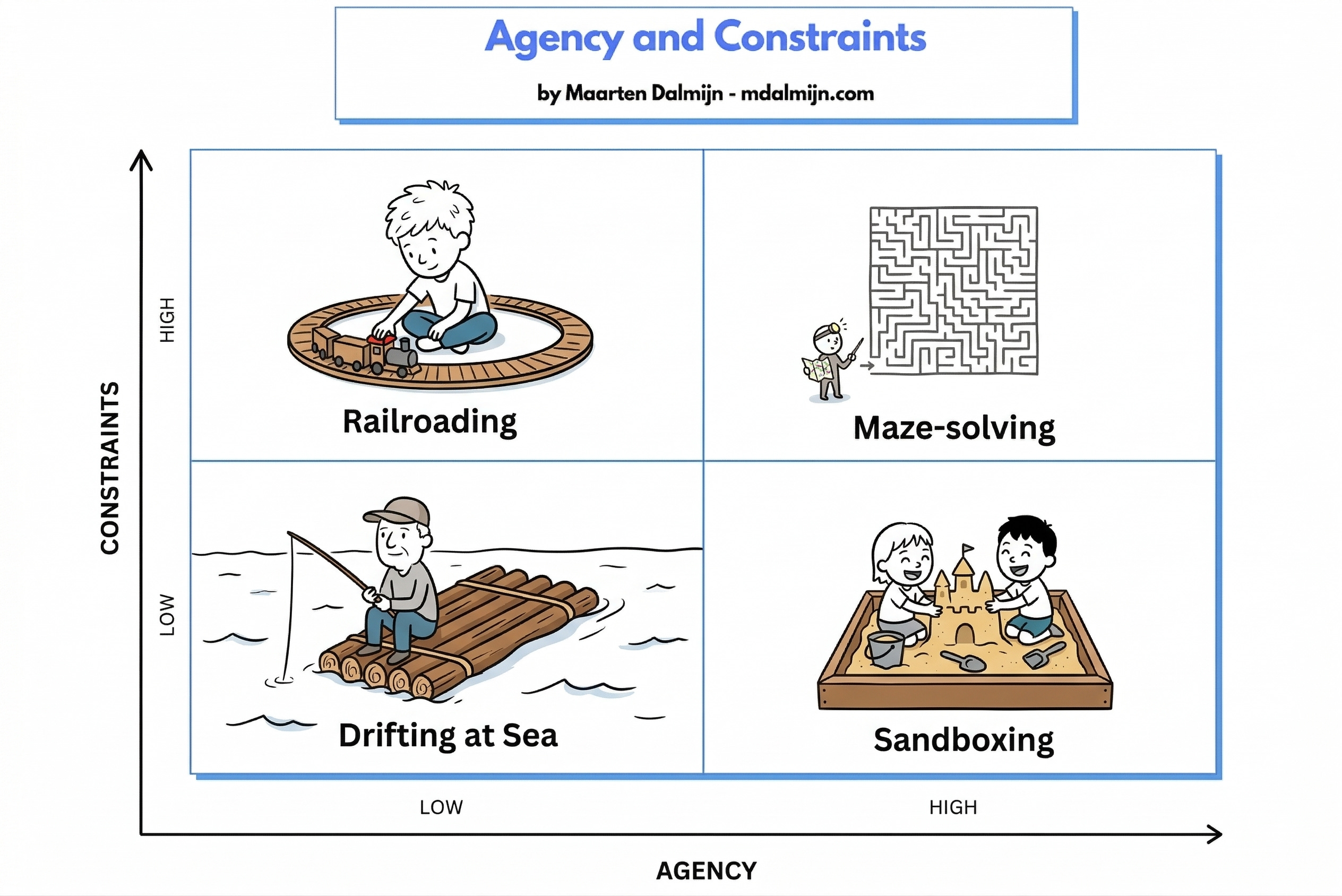
If employees experience diminished agency, it becomes difficult to solve complex problems.
If employees experience high agency, they can solve problems effectively, but the number of available options is limited by the constraints.
The most common situation at companies is one of low agency and high constraints: Railroading.
Railroading - High Constraints, Low Agency
In gaming, Railroading is a derogatory term for when player agency is restricted to go down a planned story path, regardless of player choice.
When you play a game where you’re being railroaded, everything is scripted and your choices don’t make a difference. These games can easily become boring, because your agency is basically limited to the pre-planned railroad tracks in front of you.
As companies grow, the number of constraints usually grow as well:
Rules
Layers & Hierarchy
Approvals
Processes
Silos
The combination of high internal constraints with accompanying friction and bureaucracy usually results in a low agency situation where everyone is busy keeping the train running on its tracks: railroading.
Coordination becomes more important than collaboration and the number of constraints is so high that almost all cognitive capacity is expended to keep things chugging along on the tracks.
Now, imagine you would have a magic wand and you could remove all internal constraints by waving it around, would this fix anything?
Drifting At Sea - Low Constraints, Low Agency
If anything is possible, yet your employees are not used to handling this responsibility, then you’re going to be Drifting At Sea.
People are not used to having very few constraints and being faced with infinite possibility is extremely paralyzing. Remember, agency is about the ability to achieve our goals, but that still means you need goals and you need people who are capable of handling that agency.
If you’re used to working in an over-constrained environment with lots of railroading, you will struggle once those constraints are removed because you’re going to have choice overload and unable to handle the responsbility.
Sandboxing - Low Constraints, High Agency
Remember playing in a sandbox as a kid? Anything was possible within the sandbox, despite there being clear constraints. The constraints are actually what makes agency possible, because you’re not facing the cognitive overwhelm of too many or too few choices.
A sandbox game is a video game that provides players a great degree of freedom to interact creatively, usually without a predetermined path. Think of a game like Minecraft or the Legend of Zelda: Breath of the Wild.
What’s important is that you do need the right amount and right type of constraints to have agency. Internal constraints frequently limit agency, explicit intentionally chosen constraints can enable agency.
Sometimes, you’re in a situation, despite having few internal constraints you’re still overconstrained: this is called maze-solving.
Maze-Solving - High Constraints, High Agency
In the famous Apollo 13 space mission, the second oxygen tank exploded. The crew was forced to rebreathe the oxygen inside the capsule. Over time this would result in dangerously high levels of carbon dioxide (CO2).
Engineers back in Houston put all the spare parts that were available in the Apollo 13 space craft on a table. How could they any combination of these available parts (constraint) to MacGyver a solution to prevent the astronauts dying from carbon dioxide poisoning?
They created a makeshift adapter using socks, duct tape and many other items which they dubbed ‘The Mailbox’. Here’s a picture of the Mail Box:

The ugly contraption worked and saved all the astronauts. This is an example of a problem with a high number of constraints together with high agency. You’re effectively trying to solve a maze and there are very few different solutions available.
The key thing is that these constraints are related to the problem you’re trying to solve, and not your internal constraints that limit your options of solving the problem of interest.
As otherwise those high constraints will limit your agency, and then you’re busy railroading.
The difference between rail-roading and maze-solving is the origin of the constraints that are being imposed. When you’re railroading, your organization is imposing constraints that limit your options in a way that increases your chances of becoming disconnected from the reality of the work.
When you’re maze-solving, the problem you’re trying to solve itself is imposing hard constraints which limits the different options available to solve it.
You Don’t Need Better People, You Need Better (Enabling) Constraints
If you want to prevent railroading or drifting at sea, then it’s crucial to limit internal constraints and implement powerful (enabling) constraints like
Product Vision
Product Strategy
Pull-based roadmaps with goals that provide intent
The better your vision, strategy and roadmap provides (enabling) constraints, then help foster the conditions for autonomy and agency by leaving many options off the table. They should help with sandboxing and providing the right amount of constraints.
Providing the right amount of constraints means you enable play and collaboration. You’re effectively sandboxing your teams to collaborate in an effective way. It feels like everybody is playing on the same playing field, but with different areas of expertise.
If you have too many internal constraints, or you’re imposing too many constraints on your teams, then everyone will be busy railroading and focusing on the internal logistics of making anything happen at all.
The most common symptoms of railroading your teams are:
Work is pushed to the teams.
Everybody is always in meetings.
Getting anything done is operationally taxing and decisions are slow.
Solution-focus with lots of coordination.
Lots of opportunities for cannibalization and unproductive conflict.
Decisions are front-loaded as much as possible, because that’s people deem that’s what railroad tracks need to function.
In short, railroading is a symptom of an organization that’s optimizing for overcoming internal obstacles, while sandboxing is a symptom of an organization that’s optimizing for solving real-world problems.
The question isn’t: how do we prevent having constraints? Because we need constraints to do our best work. We should be asking the following questions instead:
How do we provide the right amount of constraints, so that we promote collaboration, innovation and experimentation?
What kind of (unintentional) constraints are we imposing on our teams that limit agency and result in railroading?
Break down those railroad tracks and try to create a sandbox with the right amount of constraints so that your best people can exercise their agency. When you remove internal constraints, your teams will initially perform worse, as due to learned helplessness it will feel like they’re drifting at sea.
But if you stick with it, they will leverage those (enabling) constraints to exercise all their agency and brilliance.
Stop railroading, and start providing the right amount (enabling) constraints to support the autonomy and agency that high-performing teams need to be high-performing.
In part III, we will explore together how you can use your roadmap to quickly identify the degree of railroading that’s taking place within your organization.
Maarten did you ever hear of the (probably apocryphal) Cold War story of the Soviet defector who went back to the USSR bec he was unmanned by the multitudes of choices for every retail item? :-)
Great anecdotes & stories here, Maarten - It really brings these concepts to life.
And immediately makes me think of ways how I can enable these in my day-to-day work...