


Did you ever work at a company and wonder: “Why don’t they just trust me and let me do my job?”
Have you ever experienced the reverse and ponder: “Why are they giving me so much trust? I have no clue what I’m doing and I’ve never done this before.”
I have experienced both of these situations. Both situations are stressful and frustrating, but one is much easier to fix than the other.
Let’s explain these two situations through the lens of the Slipstream Model of Competence.
Trust Vs. Competence
We can visualize the relationship between Competence and Trust as follows:
X-axis - Competence: can you make the right decisions?
Y-axis - Trust: are you allowed to make decisions?
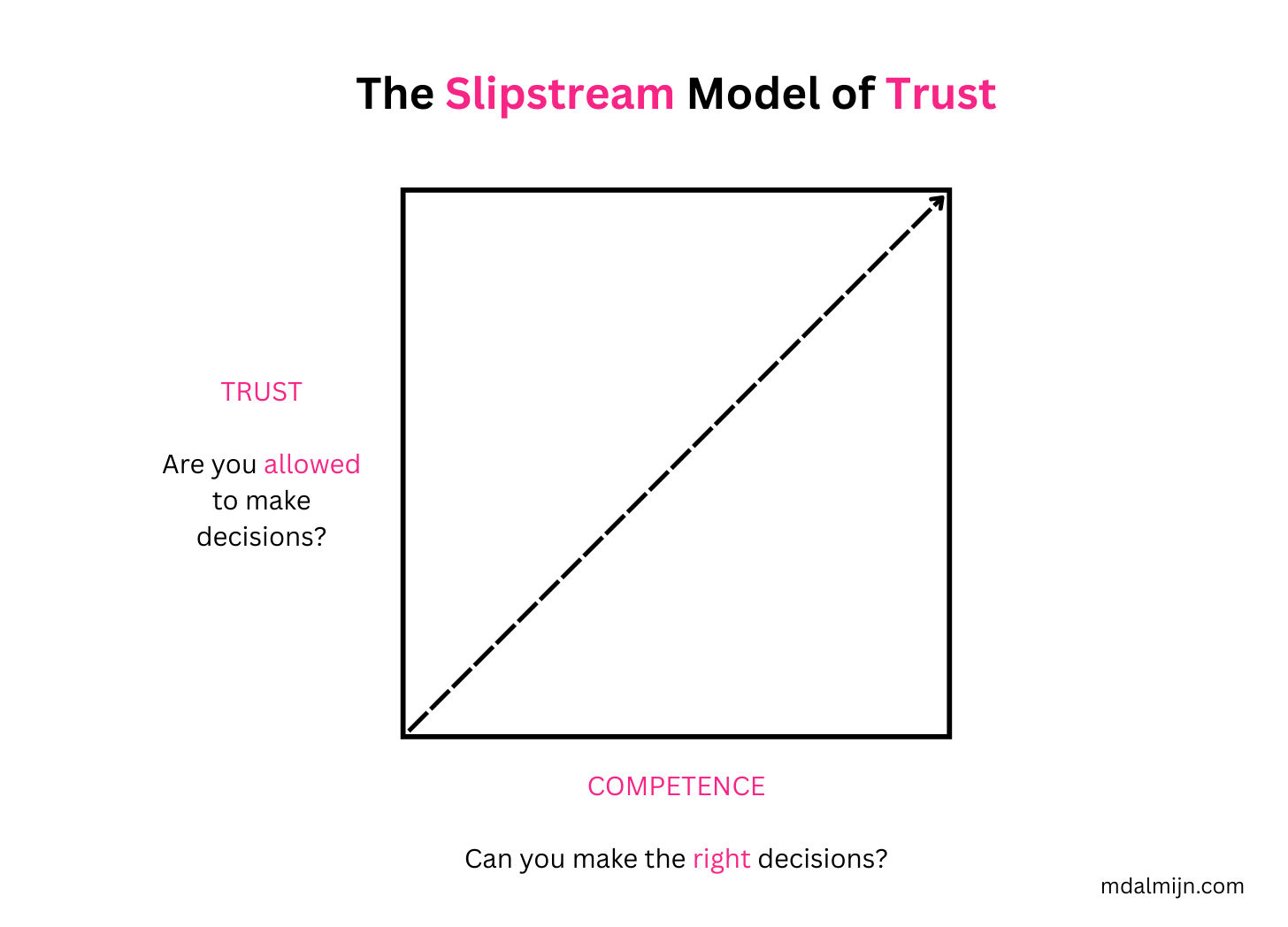
If you’re above the line, you experience more trust than you deserve based on your level of competence. If you’re below the line, you experience less trust than you deserve based on your level of competence.
Pretty simple right? By now you’re probably wondering: why is it important to consider competence and trust together in this way?
Well, that’s because the level of trust you enjoy has a big impact on your competence.
Let’s explore this using an everyday example: raising a kid. What’s really hard as a parent is that you must prevent danger for your kids, but you must also allow them to take enough risks so they can learn and grow.
In the long run: the biggest danger is that they depend on you to make decisions. At some point they will leave the house and need to make their own competence.
If you don’t trust your kid slightly more than they are capable of, you will hurt their development. If you trust your kid too much, they may hurt themselves.
When you do it well it’s a beautiful thing to behold: your trust pays off with more competence. Increased competence helps to build their self-esteem and confidence.
The end result of giving more trust than they deserve is: trust begets more trust. As they become more competent, they deserve and receive more trust.
As simple as the relationship between competence and trust seems, the ramifications are profound.
Let’s explore the relationship between trust and competence further by visualizing my first job as a Product Manager:
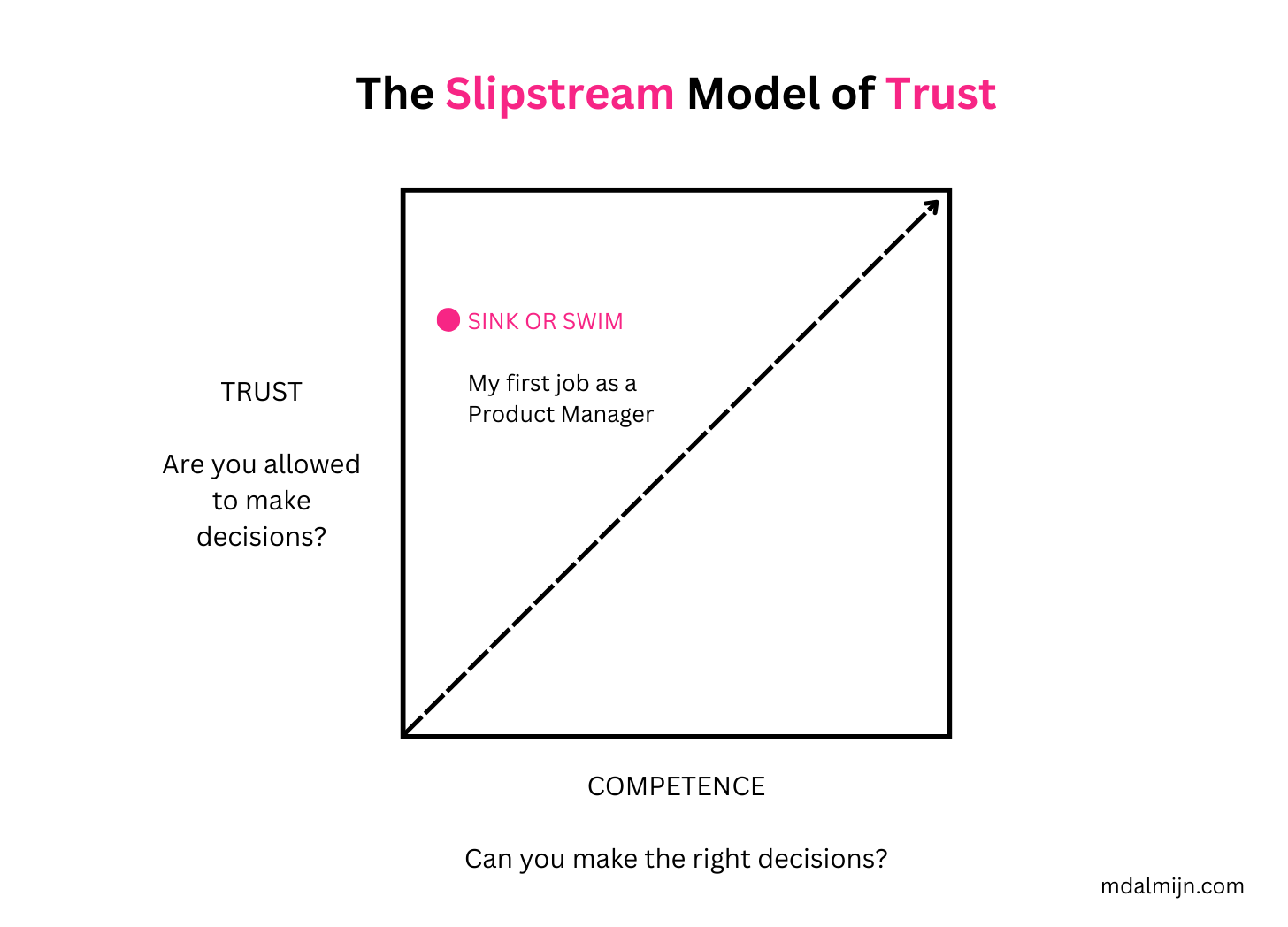
My First Job As a Product Manager: Sink or Swim
I joined one of the fastest-growing start-ups in the Netherlands. The environment was fun, turbulent, stressful and high-trust.
I remember being completely surprised about the level of trust I enjoyed, given my level of incompetence.
What happens when you’re in a situation like that? It’s called a ‘Sink or Swim’ situation. Just like you shouldn’t throw a kid in a swimming pool when they can’t swim, it’s not the best idea to put a new employee in a sink or swim situation.
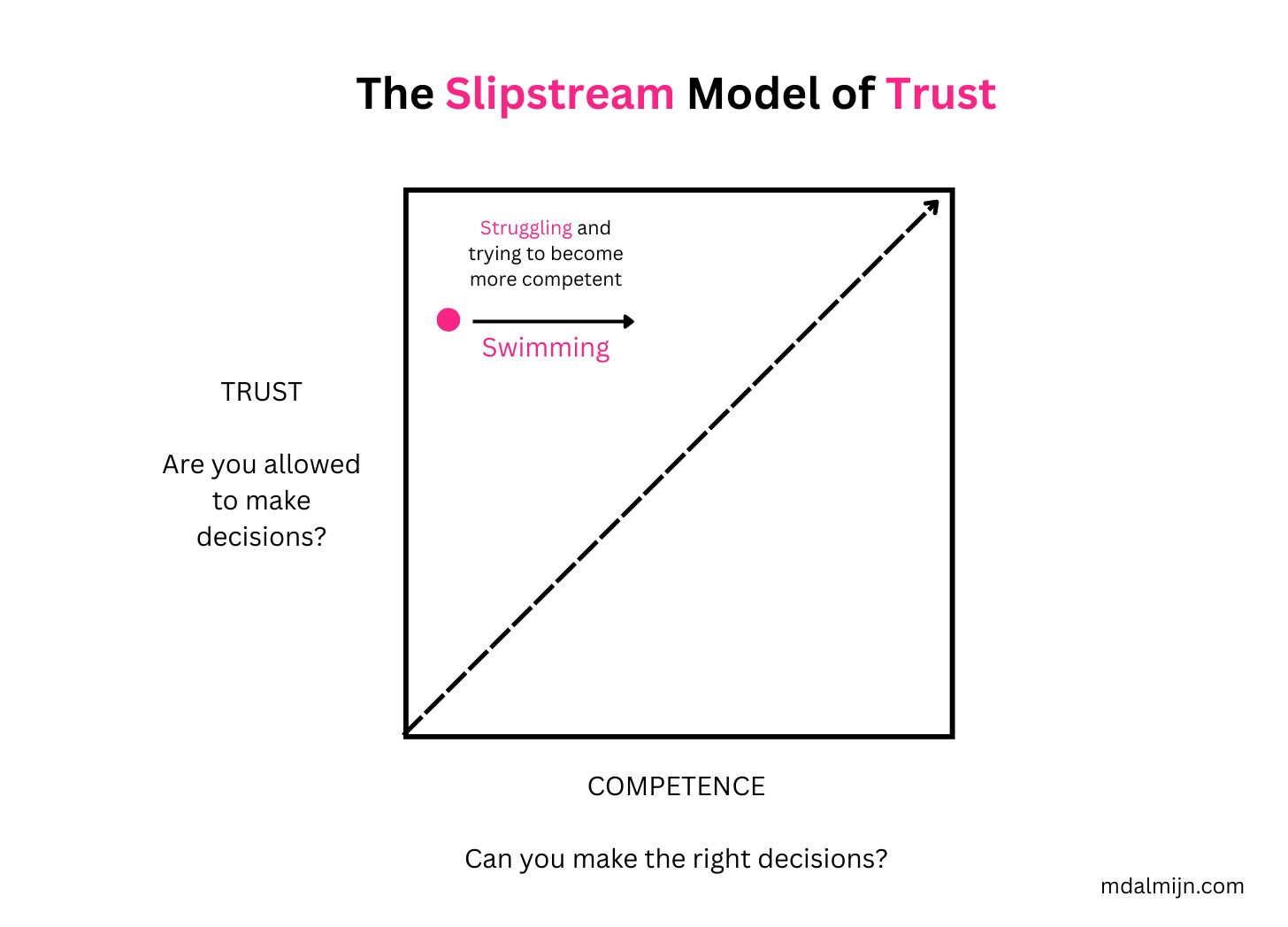
I was working overtime for many months and toiling away to grow my level of competence.
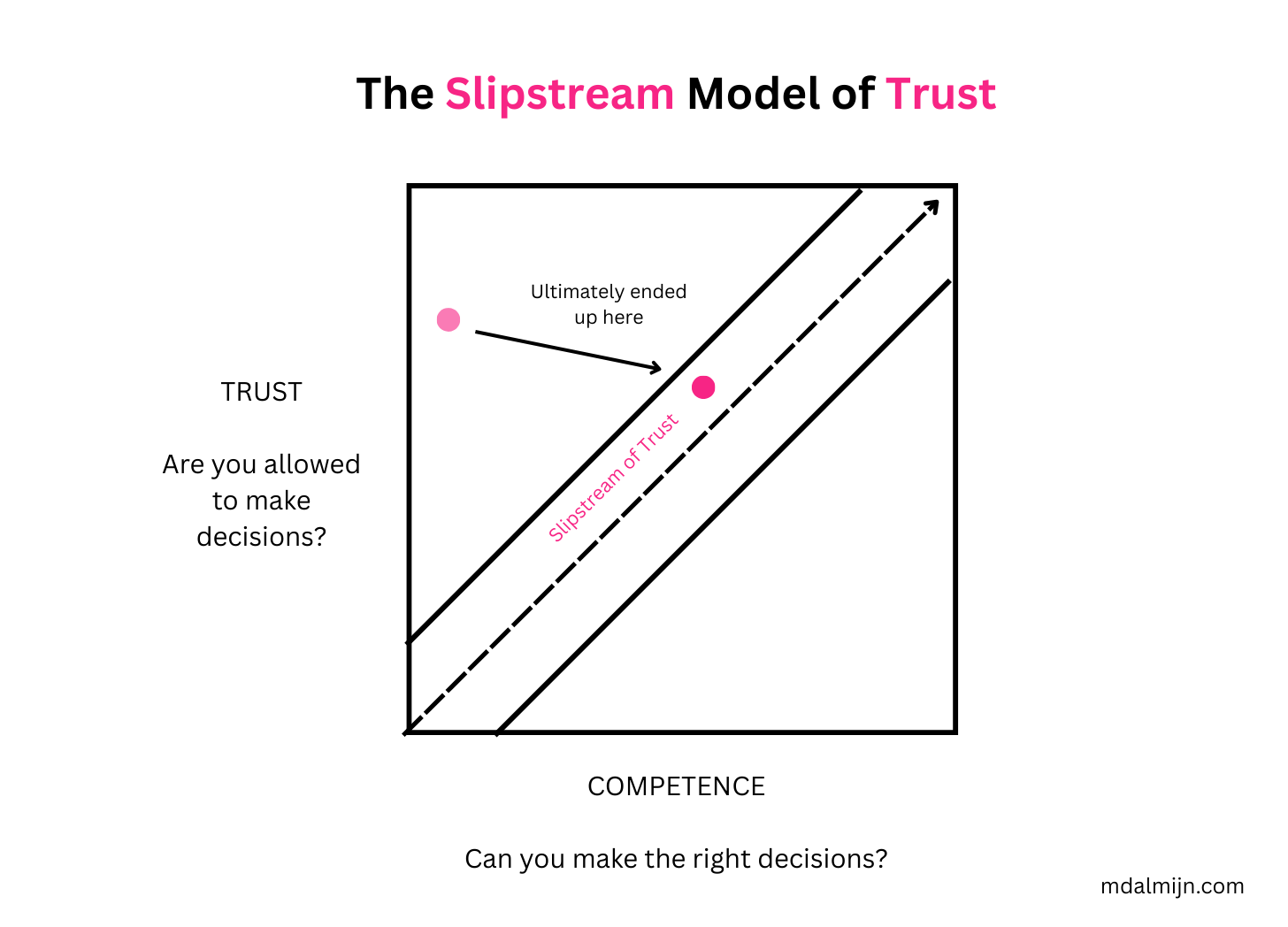
We could visualize my tricky situation as follows:
Because I was trusted to make many decisions I was incapable of making I was accumulating many mistakes. I was not only swimming, I was also sinking. It’s the only job I ever had where I was wondering why they didn’t fire me.
We can visualize this sinking of trust as follows:
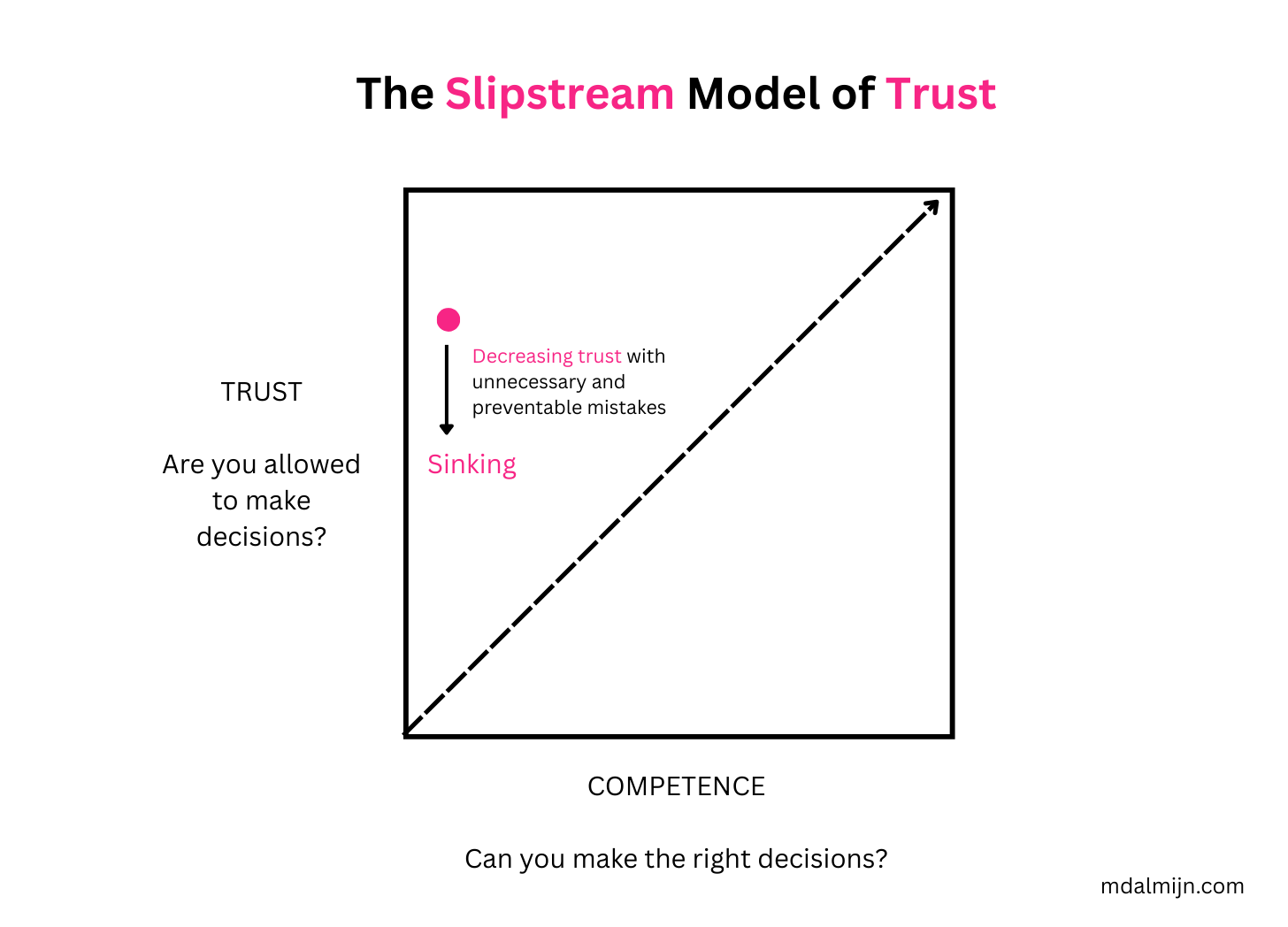
All those unnecessary and preventable mistakes were putting me at risk to demolish the level of trust I was enjoying. Luckily I wasn’t fired, because I was swimming faster than I was sinking.
As a result, at some point I ended in a comfortable place: The Slipstream of Trust. This is the place you want to be most of the time. You want to experience slightly more trust than you deserve. Being in the Slipstream of Trust means you can grow your competence further and earn even more trust than you’re currently deserve.
As a parent, I try to raise my kids in the safe environment of the Slipstream of Trust. I don’t want them to sink, but I also want them to learn how to swim. But dang, it can be hard sometimes to find the right balance.
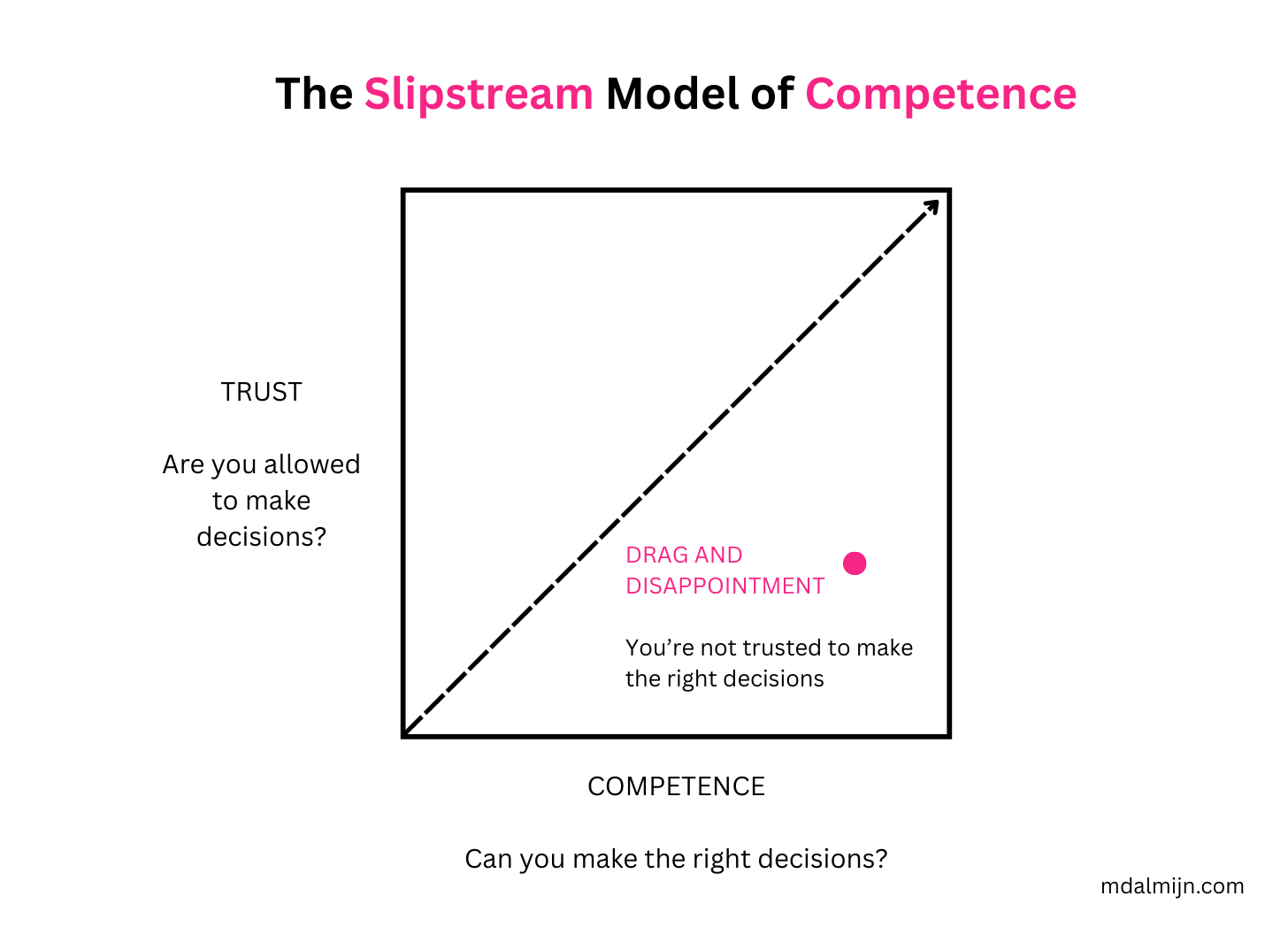
Now, let’s imagine you would start from the completely opposite situation: you experience significantly less trust than your level of competence:
My Second Job As a Product Manager: Drag and Disappointment
This is the equivalent of a parent telling a kid ‘No’ all the time and constantly repeating what they can and can’t do.
This happened to me when I left my first job as a Product Manager for a much bigger company. I worked with much smarter and better people (on paper), but I had much less ability to make decisions because of the low-trust environment.
If your level of competence is much higher than the level of trust, you will experience Drag and Disappointment. You will frequently struggle to make the right decisions, despite knowing the best course of action.
As a result of the low trust environment, you will struggle and be perceived as less competent.
We can explain why this happens using an example from the world of racing. A racer who is in the slipstream of another driver will move faster. Once you become to too far removed from the slipstream you will encounter dirty air that increases drag and will make you move slower.
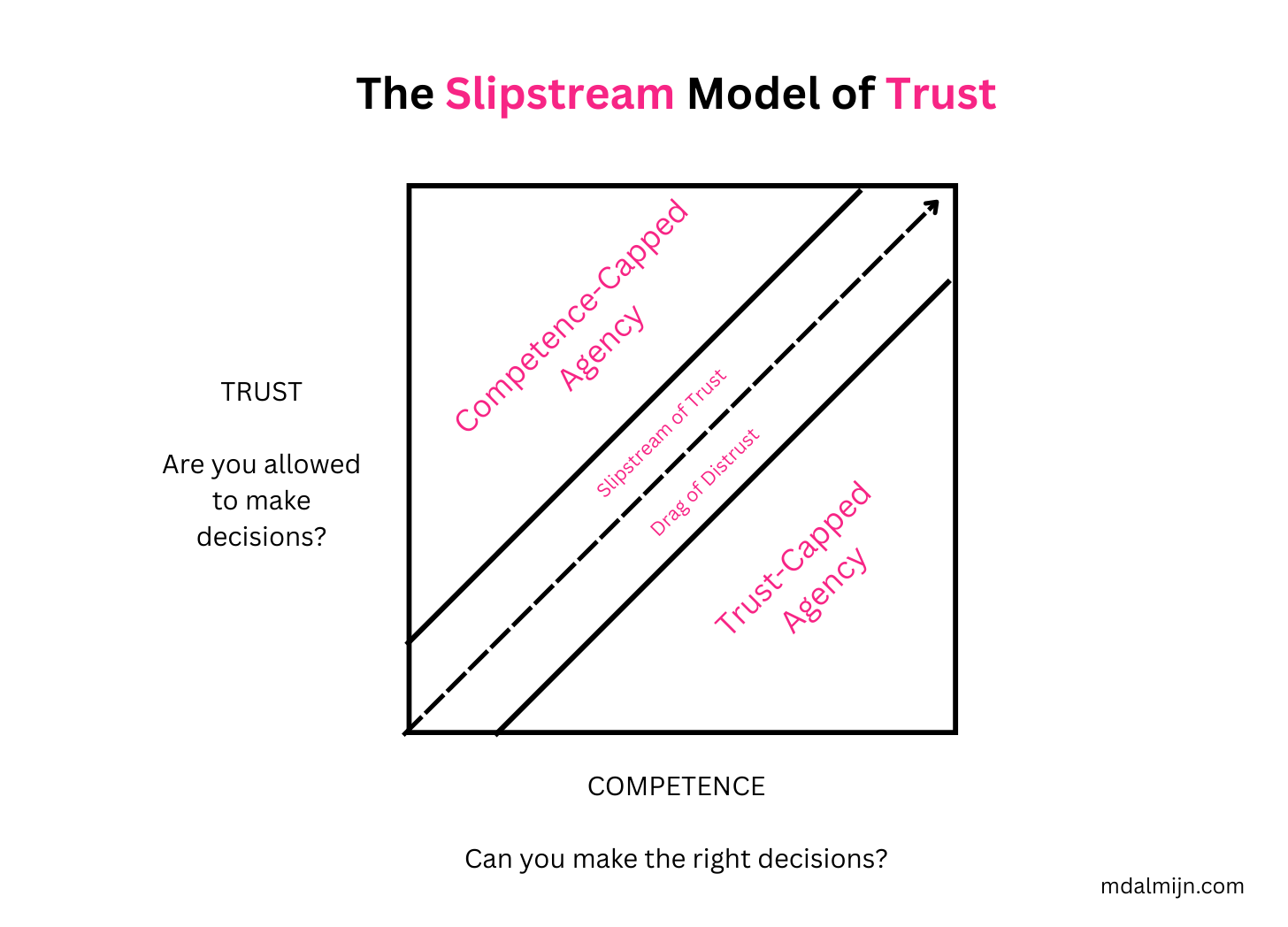
The same happens with the Slipstream of Trust. Once you leave the Slipstream of Trust and trust decreases, then you will suffer from the Drag of Distrust. You will move slower and as you struggle to make decisions you will be perceived as less competent.
As your competence drops, it will be more difficult to create trust and escape towards the Slipstream of Trust again.
Once you’re in a situation of distrust, it’s extremely hard to restore trust. Delivering results predictably, reliably and competently helps restore trust, but since distrust hurts your (perceived) competence and ability to deliver results, this is a very difficult situation to crawl out of.
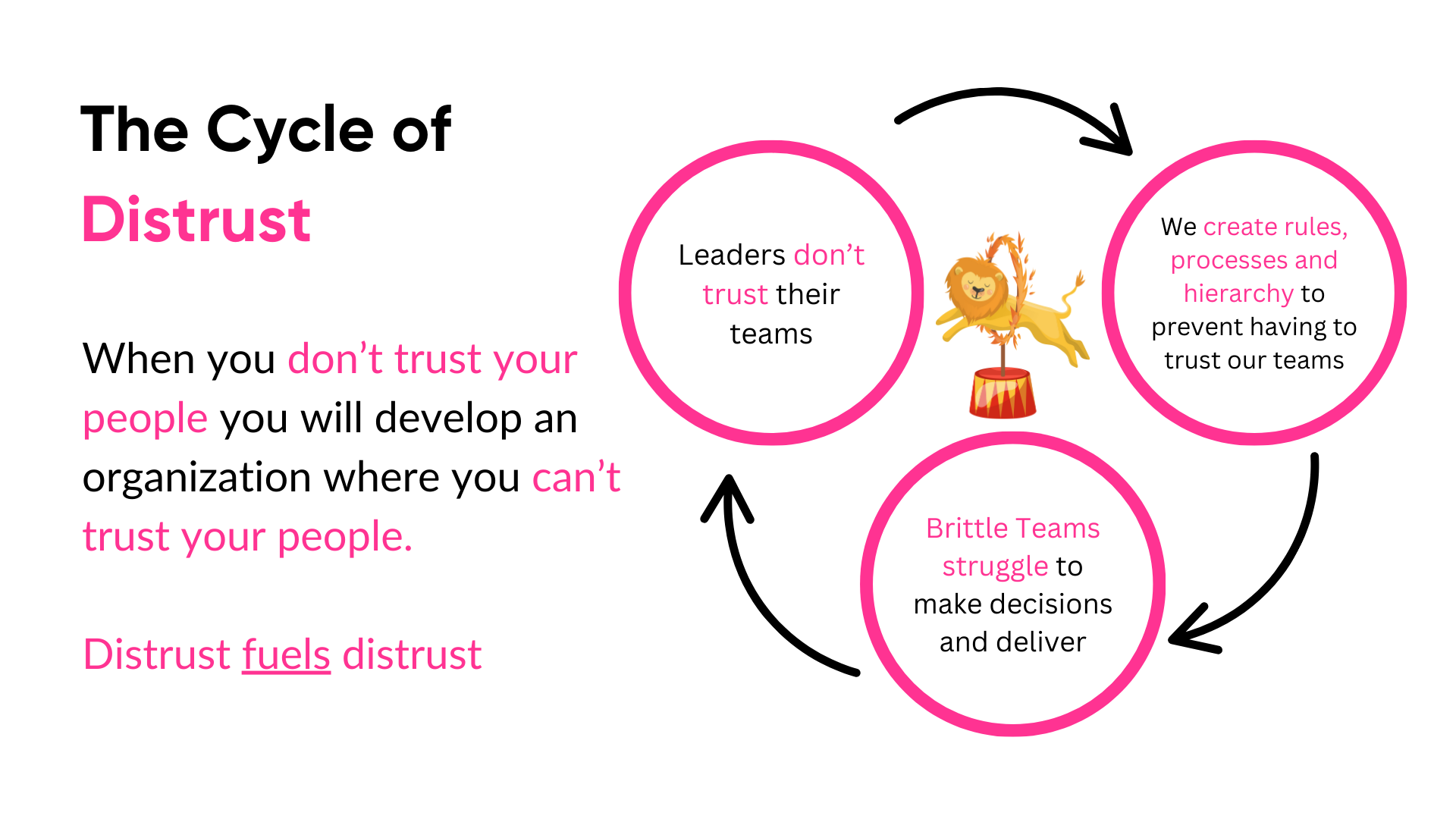
In Dutch we have a saying, trust comes by foot and leaves by horse. Once you’re below the Drag of Distrust, there is a natural tendency for teams to sink further and and create even more distrust. Which will make it even more difficult for them to become high-performing.
This is called the Cycle of Distrust I’ve written about before:
Are You Trust-Capped or Competence-Capped?
Why does understanding of all of this matter? It’s extremely important to understand whether your level of competence is Trust-Capped or Competence-Capped.
It’s important to understand this, because any progress NOT at the bottleneck is an illusion.
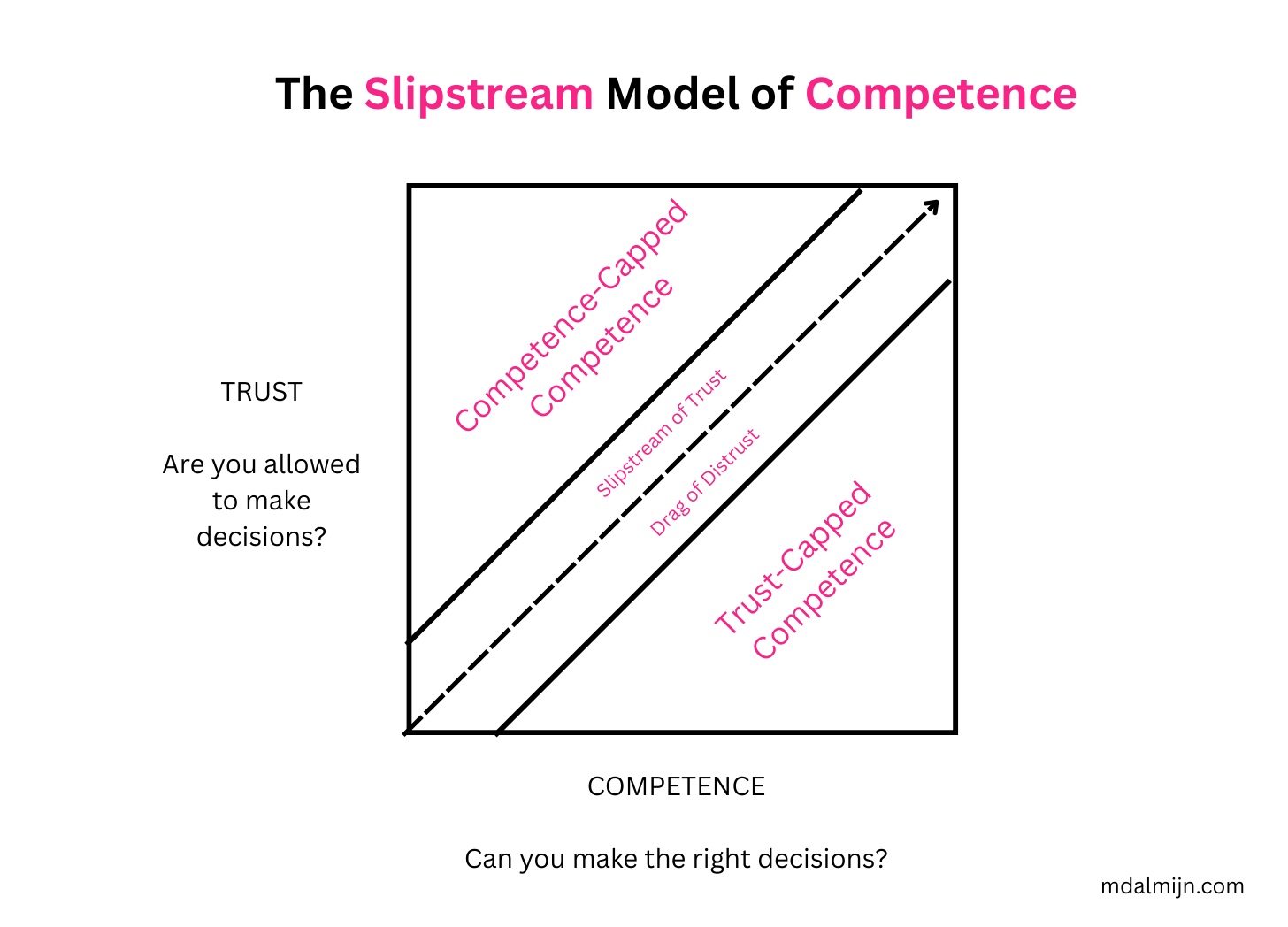
If you are in a Competence-Capped Competence situation, you should work on increasing your competence in a way that doesn’t significantly decrease trust.
Because if trust decreases too much, then you may end up being Trust-Capped together with the Drag of Distrust potentially dragging your competence down even further.
If you’re in a Trust-Capped Competence situation, you should earn trust and convince leaders to give you more trust. This may also mean getting rid of processes, rules and hierarchy.
The lower the trust, the more drag you will experience that will handicap your competence, which will hurt your ability to restore trust.
Once distrust is so high that competence is significantly impacted, it will be extremely hard to increase trust. Because that distrust will come seeping in all kinds of unnecessary bureaucracy, departments, hierarchy rules, processes and rituals, which create so much drag it will become nearly impossible to show that your competent.
The end result: distrust fuels even more distrust.
When your teams experience enough drag and disappointment, your best people will leave. You will be left with the people who choose to remain in your low trust environment.
Those are exactly the kind of people that will never get you out of that situation, because they only way they can stay and survive is by deciding to accept their low-trust fate.
Trust and competence are closely related to each other. If you want your people to be more competent, you should give them slightly more trust than they deserve.
If you want your people to gradually become more incompetent, you should give them less trust than they deserve.
Unfortunately, giving people less trust than they deserve is what most companies do. They waste a lot of time trying to hire the best people, only to put them in situations where they experience much less trust than their level of competence.
If that’s what you want to do, a much smarter (and cheaper) course of action is to hire less competent people. Because that’s what inevitably will end up happening anyway: your most competent people will leave.
If you want your people to be(come) competent, you better trust them. If you want them to become incompetent, you better distrust them.
I learned far more from working in a high trust environment with inexperienced people than I ever did from working in a low trust environment with brilliant people.
In the simplest possible terms: Trust fuels competence and competence generates trust.
Distrust fuels incompetence, which in turn creates more distrust.
Sensational piece.
The analogy with raising a kid is powerful: just like a child, a team needs to be trusted slightly more than its current competence level to actually grow and prosper.
I hadn't given this enough weight before, but I now see that trust isn't just a reward for competence, it's the fuel for it. We need to give people the space to swim (even if they risk sinking a bit). I’ll carry this lesson with me for my future career. Thank you!
This is a great depiction of the possiblities!