


AI results in the erosion of Trust.
The best way of explaining this is by talking about a bird everyone knows: the Peacock.
👋 Digging the content? Let’s talk Product☕. I’m available for Fractional Product Management, Workshops, Coaching, and Speaking.
Here’s a picture I made of a Peacock on a cannon in Madrid:
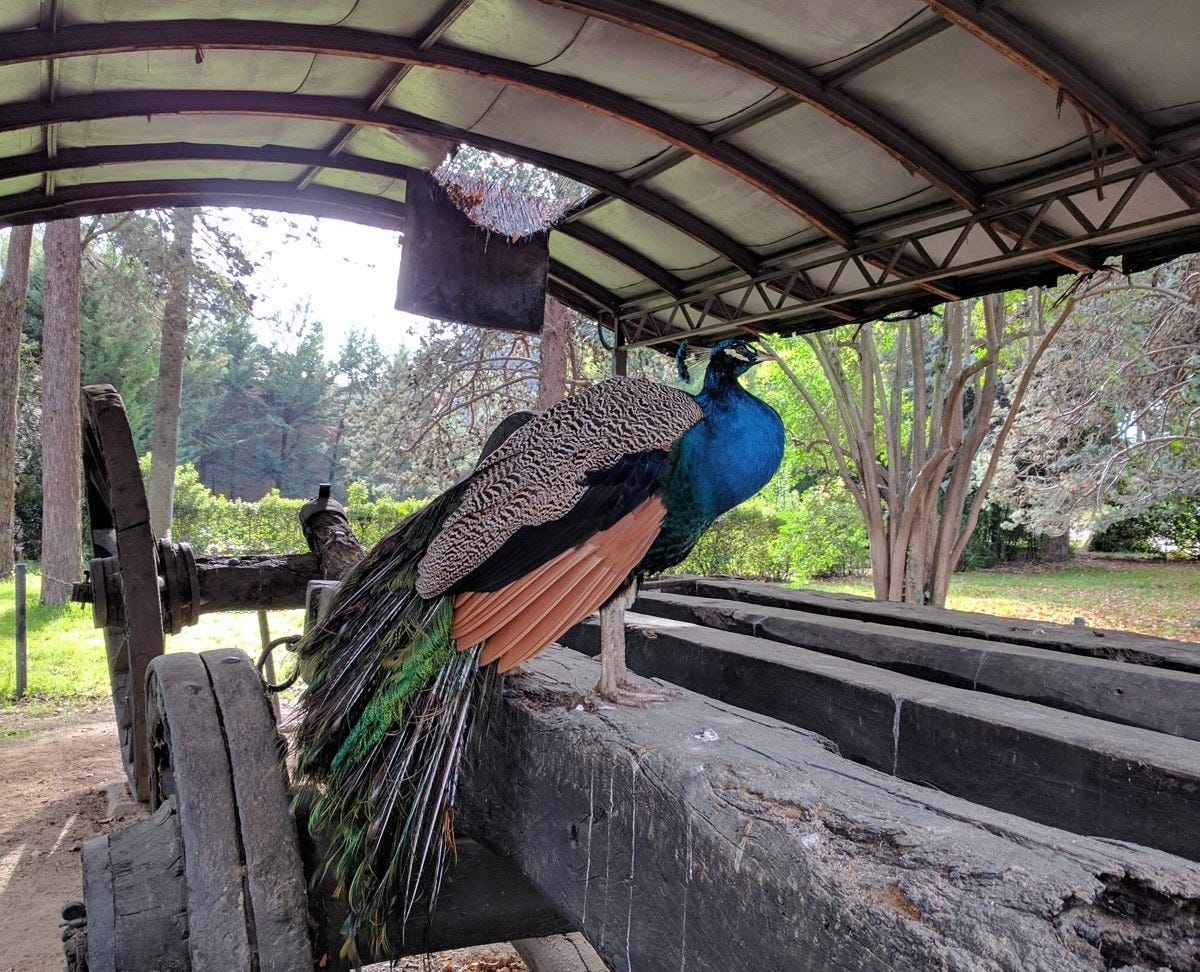
Look at the magnificent creature and ponder the following question:
Why do male Peacocks have a massive and extravagantly colorful tail?
From an evolutionary perspective the Peacock’s tail doesn’t make sense:
The tail is like a giant neon sign that says ‘Please eat me, I’m pretty’.
The sheer size and weight ruins their mobility. The tail makes up to 60% of the bird’s total body length and makes them clumsy, slow to take off and terrible at flying away from danger.
It drains energy. Growing and renewing all those massive, complex and beautiful feathers every single year takes energy, which could be better used for other purposes, like having more muscles, superior eyesight or being better able to fight diseases.
From a purely evolutionary perspective the tail already puzzled Darwin in the 19th century. Natural selection is supposed to favor traits that make organisms more fit, not less fit.
Here’s Darwin writing about the puzzling nature of the Peacock’s tail in a letter to Asa Gray on the 3rd of April 1860:
“The sight of a feather in a peacock’s tail, whenever I gaze at it, makes me sick!” - Darwin in letter to Asa Gray
The Peacock’s tail was an anomaly that made Darwin sick.
Despite all these completely valid arguments, a Peacock’s tail still evolved from evolutionary pressures that provided a benefit from having one. If the benefit isn’t increasing the fitness of the Peacock, then why do they still have such a tail?
Why Do Peacocks Have Self-Handicapping Tails?
In 1975, the Biologist Amotz Zahavi was wondering exactly these same questions: the Peacock’s tail doesn’t make any sense, yet the peacock still has one.
What is the evolutionary reason behind the self-handicapping Peacock’s tail?
Zahavi proposed the following reason which he called the Handicap Principle:
“Flashy ornaments, such as the proverbial peacock’s tail, evolved precisely because they are costly — to signal the genetic and phenotypic quality of the bearer. The handicap principle maintains that the costly signal will be honest because a weaker individual would pay a higher cost to carry the same handicap than a stronger animal. - Nature Obituary of Amotz Zahavi”
The most important part is in bold.
Zahavi reasoned that the only reason a Peacock feather works as a signal is because: “In order to be effective, signals have to be reliable; in order to be reliable, signals have to be costly.”
So how does this relate to the age of AI? Well, let’s talk about LinkedIn before the age of AI.
Let’s say you’re doom scrolling through LinkedIn before the age of AI. Every post you see, you can be pretty sure someone invested time to write that post. You could consider it a costly signal as writing a good post isn’t easy.
Also, it’s easy to distinguish the good and the bad posts, because you can easily see when someone didn’t put in any effort. We could visualize our LinkedIn timeline as follows:
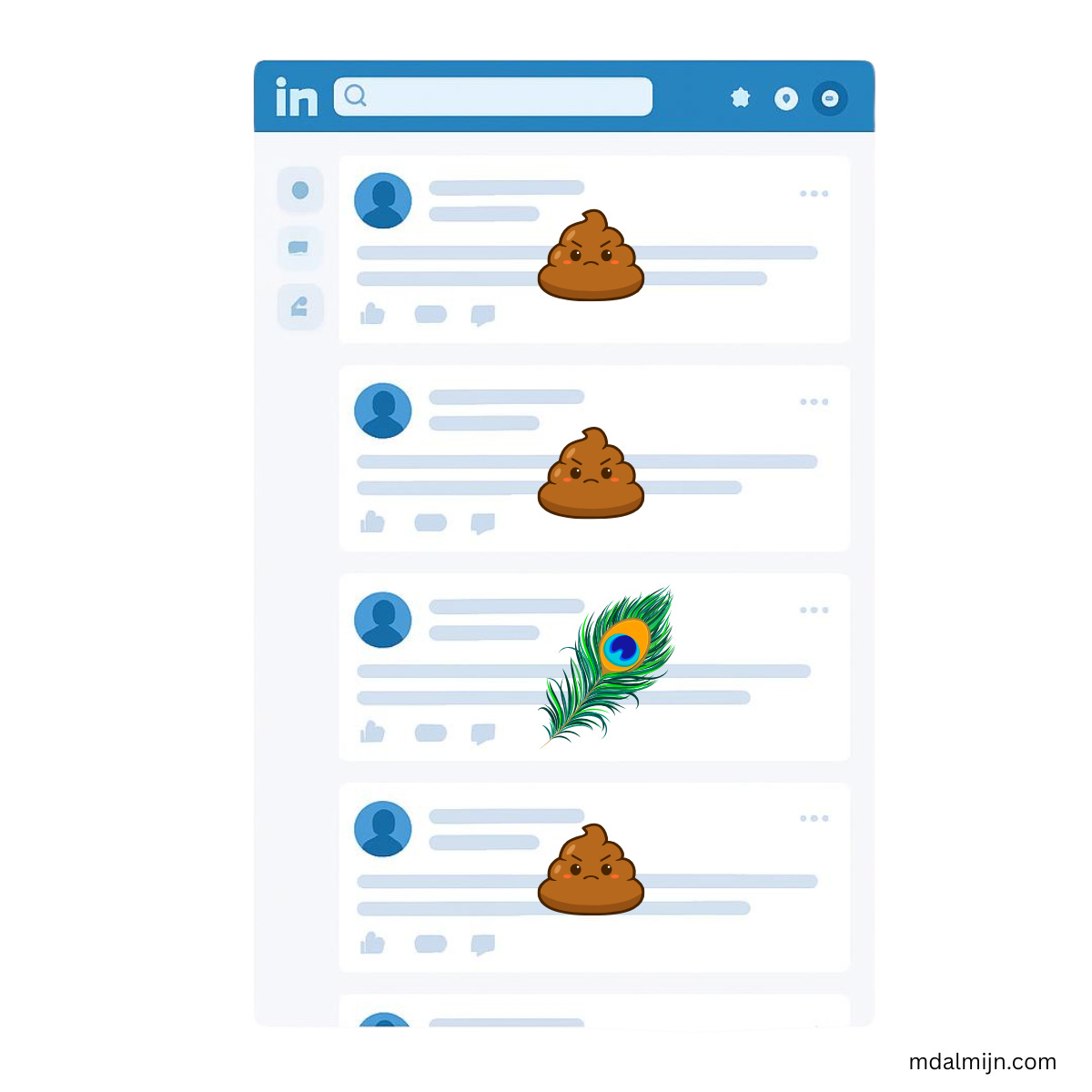
The only post you’re going to read is the one with the Peacock feather, because it seems interesting. You breeze past all the crap.
If someone wrote a lengthy and well-reasoned post, you pretty much knew it was written by them and took considerable time and effort. It might still turn out to be rubbish and uninteresting, but there’s a good chance it will be good.
The signal of decent prose is reliable and costly, just like the Peacock feather.
Flash forward to the age of AI, and when you see a lengthy, well-reasoned post, it could actually be created in 2 seconds with AI. Our AI sloppified timeline looks as follows:
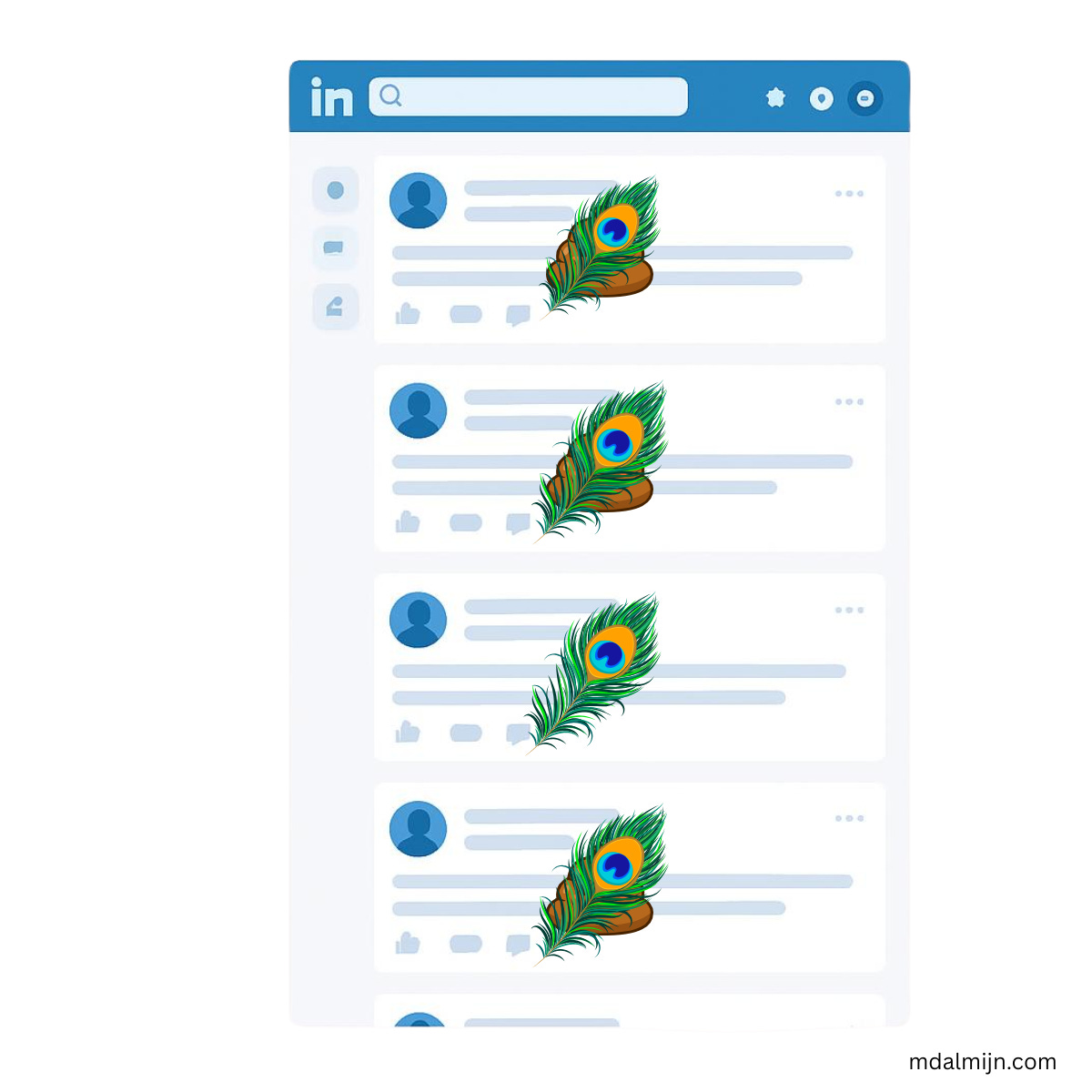
We scroll and see Peacock’s tail, but upon closer inspection it turns out to be total crap. The Peacock’s tail no longer is a costly and reliable signal that says something about the bearer.
Luckily, most posts on LinkedIn are shit, even with AI, but I’ve noticed that I no longer attach the same value to the work of other humans, because it could literally be generated in a few seconds with AI.
And as a result, I trust what they write much less. I can no longer trust upon the fact that it was a costly signal where they spent real effort, or blood, sweat and tears.
Before AI, Writing a single post was even costly. Writing a good post on a regular basis was almost insanity, the majority of writers are incapable of doing that. I remember on Medium, that the number of writers that wrote more than 3 posts was less than 1%. Today, I’m pretty sure that number no longer holds true.
Writing is no longer something costly that takes lots of time. If you see something, you can be no longer confident that someone invested lots of thinking time to write a piece. It’s no longer a reliable and costly signal.
Hence, we can no longer trust the Peacock’s tail of writers. The reliability and costliness of the signal is lost.
Mimetic Signal: The AI-Driven Erosion of Trust
There always was lots of noise. In the Great Moon Hoax of 1835, the Sun in New York published a series of articles about the alien lifeforms they discovered on the Moon.
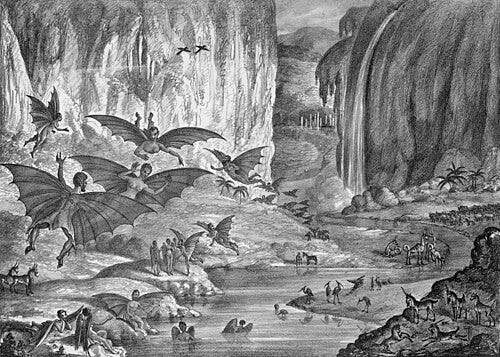
The moon was populated with man-bats and highly similar to earth. These fake articles were never retracted, but the Sun did admit the articles were fabricated one month after publishing.
However, the problem is that in the past noise was much easier to distinguish from signal. We’re being flooded mimetic signal: noise that’s actively crafted to resemble signal despite not holding any real informational value.
In short, it’s great that everyone can Peacock on LinkedIn now through the illusion of well-written posts, but we’ve lost something important:
Trust.
We can no longer trust the Peacock’s tail, because it no longer is a costly and reliable indicator of fitness. I don’t trust what I read on LinkedIn anymore, because I can’t trust it was written by a human who invested lots of time to make it happen.
I’m no longer reading much online and I’m finding myself reading more and more books, because I just can’t be bothered to wade through all the crap with fake Peacock’s feathers sticking out.
If you find someone who writes high-quality posts, share their work and subscribe to them, because they’re saving you lots of time by preventing doom scrolling through mimetic signal.
I’m highly in favor of everyone writing. I review articles and help fellow writers every week.
But throwing slop over the fence isn’t writing. All that does is make everything worse for everyone.
The only short-term solution I see is to curate your own sources you can trust, but if I figure out something else, I’ll promise to write about it.
Special thanks to Robert Kooloos for giving feedback on this piece to make it stronger.
I love this quote: "The only short-term solution I see is to curate your own sources you can trust, but if I figure out something else, I’ll promise to write about it."
I was a history major in college many decades ago, and this is the essence of critical reading, I believe from my training back then. I don't think you're going to find another solution, and it is an important solution.
Thanks for being a source I can trust!!