


If you’re making your resume right now or you’re interviewing, then the most important thing to keep in mind is this:
Your experience is irrelevant.
Nobody cares about your experience.
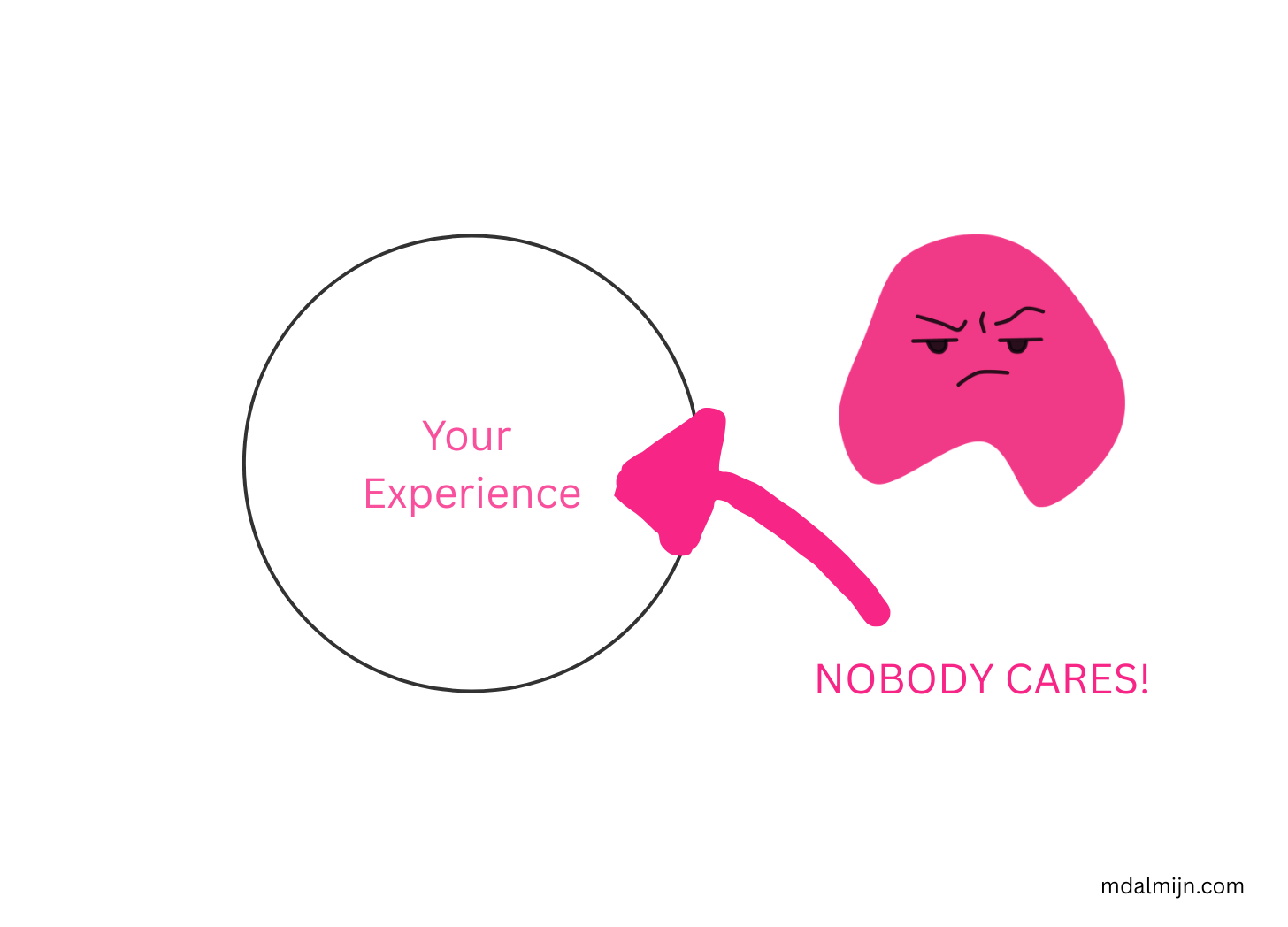
This may sound extremely harsh, but it’s the truth. The sooner you realize this, the better.
Nobody wants to hear your whole life story and all the things you did. Yada yada yada blah blah blah. The interview is not about you, but how you’re the perfect fit for the job.
👋 Digging the content? Let’s talk Product☕. I’m available for Fractional Product Management, Workshops, Coaching, and Speaking.
What they want to hear instead is this:
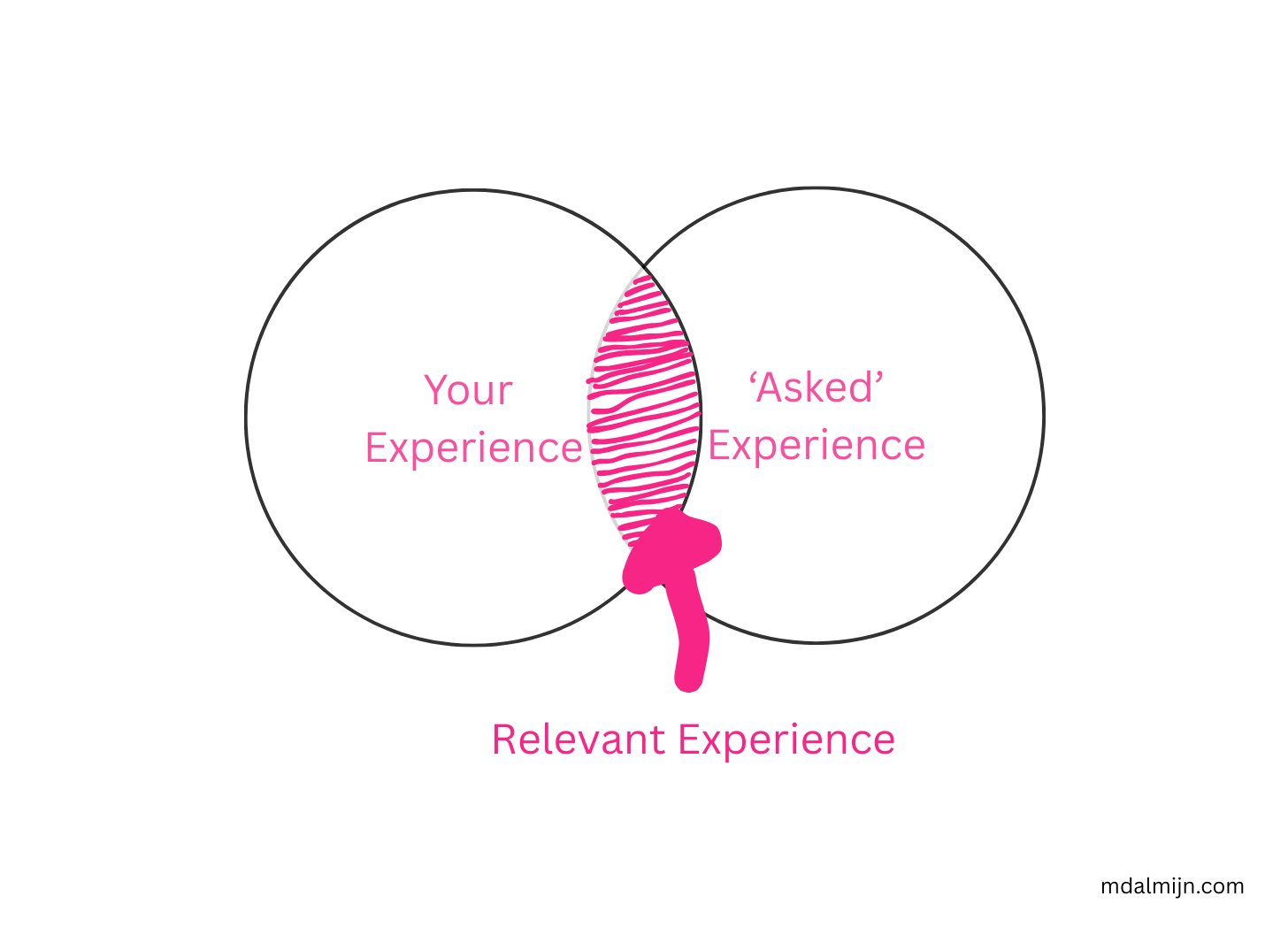
Your relevant experience is relevant and they will only remember your relevant experience if you wrap it in an interesting story. If they don’t remember, it doesn’t matter how relevant it is.
This might seem like a subtle and semantical difference, but it’s not.
Interviewing people frequently feels like you’re digging for a $20 dollar bill in a dorm room couch, meanwhile all you’re finding is ramen noodle dust and pizza crumbs.
Those resumes and interviews are the worst. Even though you’re working super hard to try to get the best out of the candidate and make them shine, they won’t play ball.
You never get any of the answers you really wanted, apart from droning, rehearsed answers that don’t tell you anything about their ability to do the job.
By the end of the interview you’re exhausted and happy it’s over.
I’m intentionally painting this frustration picture so you can experience what it’s like and why it doesn’t work. I want you to shine and succeed. What is relevant experience you might be wondering? That is highly dependent on your experience and the job you are applying to.
If you’re applying to a Product Manager job with lots of Product Management experience then relevant experience is easy. If you’re applying to a job as a Product Manager without experience as a Product Manager, then you have the much tougher job of framing apparently obscure experience as obviously highly relevant.
Let’s stop making jabs at interviewees, because interviewers are frequently even worse.
Interviewers Are Unreliable Narrators
One of the primary reasons this happens, is actually not the fault of the interviewee but of the interviewer. You should always treat the interviewer as an unreliable narrator:
What they ask for, is not necessarily what they want.
What the they want is not necessarily what they need.
What they need, is not necessarily what they want.
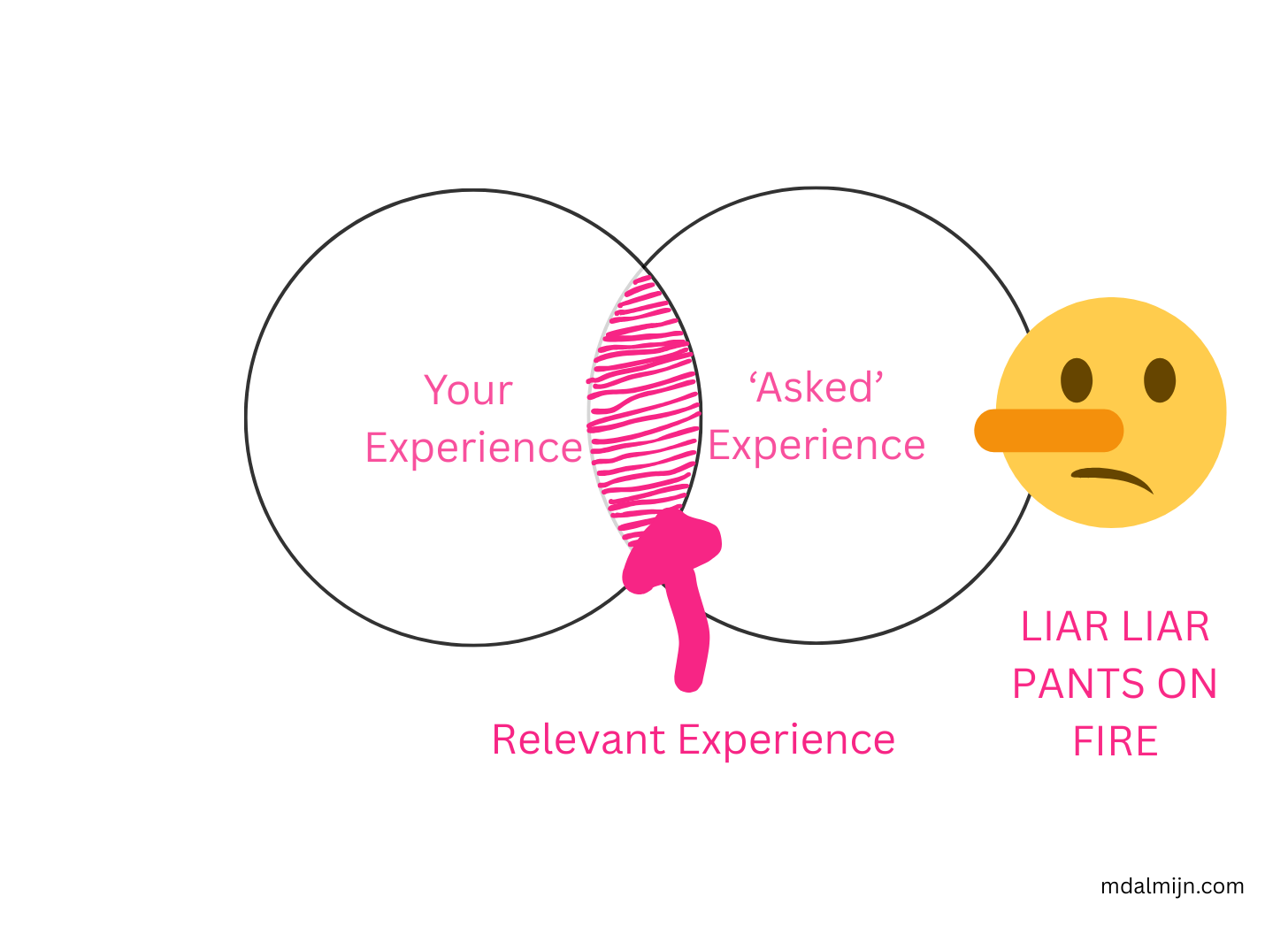
Frequently the ‘Asked’ Experience is a classic case of unintended “Liar liar pants on fire”.
Watch out if you’ve diligently prepared your interview, as it might be a trap.
All the experience you think they care about is not what they care about at all. Telling them the experience you believe to be relevant will actually be a total waste of their time.
I want to stress, treating them as an unreliable narrator doesn’t mean you should second-guess or challenge them like they don’t know what they want. That’s a guaranteed way to never get hired, as nobody wants to work with a smart-ass who can’t read the room.
But you should get them to paraphrase what kind of person they’re looking to hire and treat every question as a clue to what kind of candidate they’re really looking for.
Keep your eyes open for clues of congruence, as that will help you to better position yourself and give the answers they actually care about.
Spot Clues of Congruence
The best-case scenario is that they’re congruent. The kind of questions the job interviewers ask match the expectations set in the job description.
This congruence is unfortunately rare and you should do your best to maximize the opportunity, because all the stars are aligned and it’s now your opportunity to shine!
The worst-case scenario is that the interviewer’s narrative is completely incongruent. In that case, you should trust what the different interviewers are telling you over whatever is written down in the vacancy and think quick on your feet.
Why does this happen?
Whatever is in the vacancy, might be written by someone in HR, who doesn’t have the faintest clue about the actual job. In fact, sometimes the vacancy hasn’t been updated in years. These are all red flags by the way, but this is more common than you’d think.
Even if the vacancy is accurate, whoever is interviewing might not even know it by heart. How do you deal with this unreliable narrator situation?
When you write your resume, but also when you answer questions, remember why you’re here.
You’re not here to tell your experience. You’re not here to tell your whole life story or all the things you did. You want to tell a story that helps the interviewer answer the following simple question:
"Do I Trust You’re Capable of Doing the Job?”?
The key word here being: building trust.
You don’t build trust only by giving all the right textbook answers. Nobody wants to work with a drone. You build trust by being a real, interesting and interested human being.
The moment when the interview is over, you want the interviewer to remember you, not just for what you’re capable of but for who you are.
What makes you different? Sometimes the one tiny thing you’ve told them makes you stand out from everybody else becomes way more important than being the best.
Different is frequently better than best.
When you write your resume, but also when you answer questions, always keep the following model in mind:
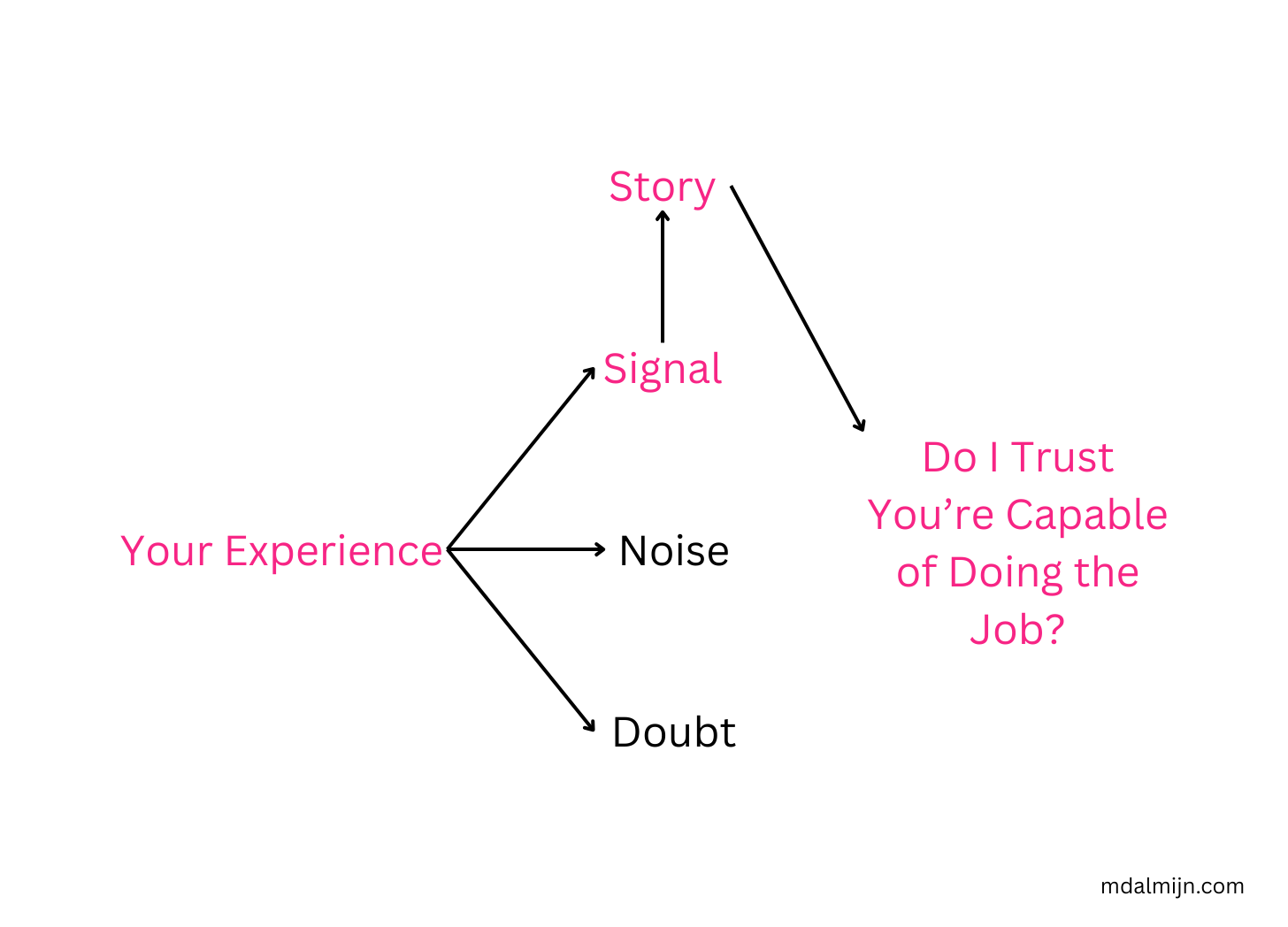
Your experience can be split in three parts, which in essence all boil down to ‘Trust Signaling’ to answer the following question: “Do I Trust You’re Capable of Doing the Job?”
Signal. Anything that increases Trust you’re capable of doing the job.
Noise. Anything that distracts or might drown out the Trust of you’re capable of doing the job.
Doubt. Anything that decreases the Trust that you’re capable of doing the job.
Go through your resume, and mark every line on there either as Signal, Doubt or Trust. Remove anything that isn’t Signal.
Apply ‘Experience Dilation’ for the parts that provide Signal. If something is especially relevant, stretch it, but of course don’t do it such an extent it turns into Noise or Doubt.
Remove duplicate Signal. If you’ve done the same thing at three jobs, I know you’re capable of it after the first job. Don’t provide the same level of detail for all three, because that’s noise.
Think hard now that you’re reading this post: what will you remember from what I’ve written?
The only thing you will remember is the story that played out in your mind.
The better I do my job, the more this piece felt like a story in your brain that evoked emotions. You might even disagree with some things, which is all fine.
You might remember what you agreed with, if I did a good job of wrapping it in an emotional story that resonated with you.
You should do the same when you’re interviewing: Story-Driven Interviewing.
Story-Driven Interviewing: Serving Your Relevant Experience On a Silver Platter
Tell a story, with concrete details and emotions. You can’t fake that and it builds trust more than anything else. People are connected through stories and story-telling: we remember stories and emotions. It’s the thing that made religion big.
We struggle with remembering facts unless they’re part of a larger narrative. Facts without a story are boring. Our brains have been TikTokked. You must break the pattern and invite curiosity before people will listen.
In short: nobody cares about your experience. Get over it.
You’re a human being and you’re different. Different is better than just better.
Stop sinking yourself by drowning interviewers with all your experience. Tell a story that builds trust that you’re capable of doing the job.
It’s incredibly hard, but the alternative is that when you leave the interviewing room is that nobody will remember you.
Your experience is irrelevant.
Only your relevant experience is relevant, and it’s only relevant if they remember it.
People only remember the relevant experience you served to them on a silver platter by telling an emotional story only you could tell.
What’s the relevant story only you can tell? That’s what you should be thinking about.
Great post. "Nobody cares about your experience," and "Do I trust you are capable of doing the job"
How do all the HR AI agents take part in this exercise?