


Autonomy is one of the most misunderstood concepts in Agile and Product Management circles. Many people believe giving people more autonomy is a sure-fire recipe for success. Autonomy sometimes even gets conflated with ‘Empowered Teams’.
We’re fooling ourselves if we believe autonomy is the wonder pill that makes everything better.
In fact, it may only make things worse.
👋 Digging the content? Let’s talk Product☕. I’m available for Fractional Product Management, Workshops, Coaching, and Speaking.
We’re going to explore the following three misconceptions together:
Being autonomous means you can make completely independent decisions.
More autonomy is always better.
Autonomy is more important than alignment.
Autonomy ≠ Independence
Daniel Pink, who coined and popularized Autonomy, Mastery and Purpose in his magnificent book Drive, defines autonomy as follows:
“Autonomy is the desire to be self-directed, it increases engagement over compliance.” - Wikipedia
I want to emphasize, that the model of Pink is rooted in Self-determination Theory based on the pioneering research of Deci and Ryan, who created the original model with different labels: Autonomy, Competence and Relatedness.
Autonomy is not about being independent, it’s about acting with choice. Autonomy means carrying yourself with a sense of volition. You’re doing what you’re doing because it’s your choice to do so.
If another team gives instructions and tells you what you must do without additional context, that hurts autonomy: your self-direction and ability to choose.
If another team asks for your help and you decide to help them, even if you would be doing the exact same thing that they would have instructed you to do, then your autonomy is preserved.
Same end result, but a completely different outcome from the perspective of autonomy.
Autonomy has nothing to do with being completely independent, because we all know that is a fantasy in the modern workplace.
It’s incredibly rare that we’re a lone cowboy working in the Wild West.
Low Alignment = Independence
Autonomy is not about being independent of others. You can be highly autonomous AND be highly dependent on other teams.
Look at this picture of Aligned Autonomy by Henrik Kniberg from the famous Spotify Model:
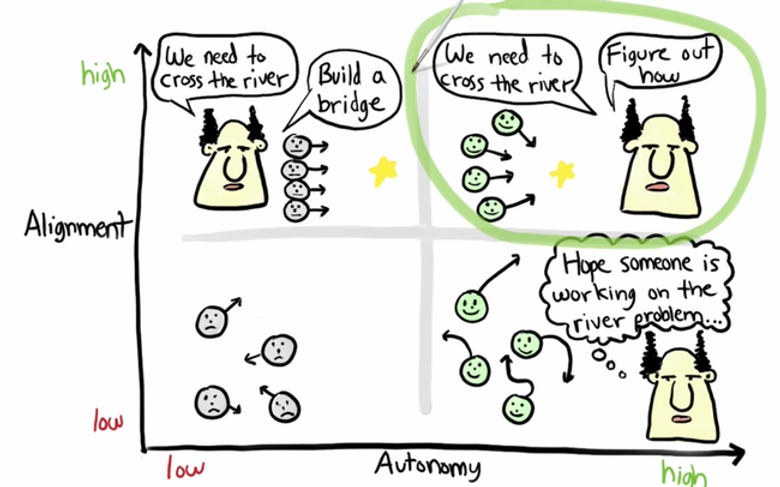
Do you see anywhere in this matrix that autonomy is about working independently?
No, absolutely not. The matrix tells a completely opposite story: autonomy has nothing to do with independence.
The top left situation of high alignment and low autonomy shows everyone is still pulling in the same direction. They’re just less motivated and driven (see the sad faces) due to the lack of autonomy. The bottom half of the 2 x 2 matrix actually depicts the situation where everyone is doing their own thing, even if they score high on autonomy.
Low alignment is what causes people to work independently and not low autonomy.
Lack of Alignment = Independent Action
Let’s assume you have teams that are truly independent: they don’t need each other and don’t affect each other in any way. I want to emphasize this is a purely hypothetical example that rarely exists in the real world, but just try to follow my line of reasoning.
If teams are truly independent and don’t need each other in any shape or form, then alignment between teams becomes completely irrelevant. Everybody will move in their own direction, but given their independence it doesn’t matter.
I live in the Netherlands and somewhere in Australia there is a random person living their own life who also has a family with wife and two kids. Our families are not aligned in any way and it doesn’t matter because we’re literally living on the other side of the world minding our own business.
The problem is that our teams are not randomly constructed and they frequently do need each other.
In reality, if you’re working at a company, you’re invariably dependent on others outside the team in some shape or form. You’re not living in a completely different world in an insular bubble. You’re sharing a workplace environment that only works well if everyone plays ball together.
In a situation where teams depend on each other, alignment is more important than autonomy, because in such a scenario you can’t have autonomy without alignment.
No Autonomy Without Alignment
We need alignment for two reasons:
In the real world, teams do depend on each other. No matter how you structure them, they will need coordination or collaboration outside the team. Whether it’s HR, buying a new software license, or making sure everybody attends a security training, it doesn’t matter.
Autonomous teams that depend on each other require alignment. If your teams are heavily dependent on each other, then you can’t have autonomy without alignment.
When you take both of these points together: the situation of high autonomy and low alignment rarely exists in the real world, because teams that heavily depend on each other won’t have autonomy when they have low alignment.
When you have many teams working on the same product, even if they own independent features, domains, or different parts of the user journey, they will still need to be aligned. You could even argue that the way their teams are split up is already an implicit form of alignment.
If you’re in a situation of low alignment where many teams must collaborate with each other to create value and capture it for the business, then you roughly have two scenario’s:
One team chooses and gets exactly what’s they want. They enjoy high autonomy while the other teams don’t.
Everybody wants to exercise their autonomy in an environment of low alignment. Low alignment results in conflict and they struggle to reach agreement. Nobody has the freedom to choose and nobody gets what they want. The end result is diminished autonomy and teams may even end up undermining or sabotaging each other.
Autonomy is about maximizing the degrees of freedom so people can make the right choice, but it’s not about maximizing the degrees of freedom in isolation or at the expense of others.
When teams are dependent on each other, then the lack of alignment will hurt their autonomy. Lack of alignment in combination with the desire for autonomous teams is actually one of the primary reasons that companies end up working in silos.
Silos are not a symptom of low autonomy, they are a symptom of low alignment. The low alignment also produces low autonomy, but the root cause is the lack of alignment.
When teams have low alignment while they desire high autonomy, they will create silos to try and preserve the illusion of high autonomy. Teams will latch on to the little strands of autonomy they still have with their little fingers until their knuckles turn white.
The end result of trying to preserve high autonomy in an environment of low alignment is what I’d like to call ‘Snow Globe Ownership’, where every team is trying to operate from the insulated world of their perfect and magnificent little snow globe.

The snow globe is the only place where the team can enjoy high ownership and autonomy. We all know the snow globe is a lie, as there is a whole big scary world outside of the snow globe that matters far more than the team would like to admit.
Life is great as long as we stay in the snow globe. As long as everybody stays in their lane, we can have good things. But because we still need each other, we can’t have good things. The problem is that the snow globe approach fails when we need each other, because each snow globe looks at the problem from their limited and insular perspective.
Everybody is trying to maximize autonomy from the limited vantage point of their snow globe. There is the illusion of high autonomy when teams don’t need each other, but if you look at the big picture, the actual autonomy is low because there is no alignment.
You don’t fix silos by increasing autonomy, you fix them by first addressing alignment. Only when you fix alignment will it become possible to have high autonomy outside the myopic realm of the snow globes.
In summary: you can’t have autonomy without alignment. At least not when team need to work together to succeed.
Alignment Beats Autonomy
I believe we should not be talking about Aligned Autonomy, because in the real world talking about aligned autonomy is like talking about cold snow: you can’t have snow when it’s not cold and you can’t have autonomy without alignment.
Remember how I started this article with two false statements:
More autonomy is always better.
Being autonomous means you can make completely independent decisions.
In the real world, Autonomy does not exist in a vacuum. We inevitably need other teams or people outside our team.
The work we do, frequently does depend on others. In this context, if you incorrectly define autonomy as being able to act independently, then more autonomy for one team by definition, will hurt the autonomy of other teams.
The reason why autonomy frequently gets conflated with independence is because the moment teams are highly dependent on each other, then that increases the chance one team will begin telling another team what to do, which puts autonomy at risk. Telling people what they must do without them having a say is the opposite of autonomy.
Instead of giving orders and instructions, turn it into a conversation where everybody chooses to collaborate with each other to find the overall best solution. The only way this kind of collaboration can happen is when there is high alignment.
When there is low alignment, people will actually begin giving instructions to other teams to prevent collaboration from happening. They will cross their fingers that by simply throwing instructions over the fence we won’t end up in conflict and disaster due to the lack of alignment.
High Alignment Enables High Autonomy
In conclusion, high alignment is what opens the door for autonomy and collaboration. When teams are properly aligned, there is decent chance they will self-issue the same instructions in collaboration that you would have given them in isolation.
The end result may seem the same, but don’t be fooled, the difference is massive: you’re respecting their autonomy. Your teams will be highly engaged and highly motivated.
Why does understanding the the tight coupling between alignment and autonomy matter?
When you optimize for autonomy without addressing alignment, then you’re going to have neither autonomy and alignment.
Lack of autonomy isn’t the reason the Spotify Model failed at most companies. Increasing autonomy for individual teams, while not addressing alignment, means you’re actually going to reduce autonomy further and create even more silos. That’s why the Spotify model failed.
Restructuring teams is easy, addressing the fundamental alignment problems is infinitely harder. Without addressing alignment, the team structure won’t matter much.
Every team will make autonomous decisions without understanding how it affects others, thus diminishing each others autonomy even further.
Alignment = Providing (Enabling) Constraints
Silos are extremely common and are what happens when everybody will optimize for their own autonomy at the expense of the big picture due to lack of alignment.
The best thing you can do if you want your teams to make better choices is by limiting their options in a way that increasing their chances of making better choices.
This is exactly what makes alignment hard. We hate limiting choices and the immediate sting of saying no to things. The moment we limit choices, loss aversion kicks in, but it’s actually what’s necessary for high autonomy when many teams must collaborate together.
Limiting choices sounds extremely counter-intuitive, because we defined autonomy as the ability to self-direct and make choices, but constraints are actually the guard rails that make autonomy possible in the context of a multi-team environment where they need each other to succeed.
Alignment is about providing (enabling) constraints, like Vision, Strategy and Goals that intentionally limit the different options for teams so it becomes easier to operate in the same direction with the same intent.
Constraints are not rules, they don’t tell you what to do, but they enable you to make better decisions about the right course of action beyond the scope of the snow globe. Constraints are actually what makes collaboration possible, because if you don’t have constraints, then it becomes really difficult to make decisions.
Without clear (enabling) constraints, everybody will self-invent their own constraints from their limited team or department perspective to make the right decisions possible. And because everyone has their own constraints and agenda, they will be serving the insular perspective of their little snow globe and diminish each other’s autonomy.
Only when you have sufficient overlapping constraints does it becomes easier for teams to make collaborative choices in a way that serves the best interests of the company.
As a concrete example: providing a list of 100 things that must be delivered next quarter limits options, but it does so in a way that actually limits their chances of making better choices by hurting both alignment and autonomy.
If you have alignment problems, then your lack of autonomy is the least of your concerns. Fix alignment first. Alignment is what helps make autonomy possible when many different teams must collaborate together to succeed.
Don’t tell people what to do, but provide them with (enabling) constraints together with intent. That’s the best way to have high autonomy and alignment.
If you’re telling people what to do, then you can’t have high alignment, because you’re not providing (enabling) constraints. The moment the plan goes off the rails, everybody will struggle to align and you won’t have autonomy nor alignment.
Providing (enabling) constraints will hurt more right now so that you will have potentially less pain later. As long as we can’t accept the sting of guaranteed early loss by providing (enabling) constraints, we will guarantee late loss by working in silos and autonomy won’t be able to shine.
This is great points! I like the notion of „enabling constraint“ especially well because it is a fantastic metaphor for the solution to alignment-capability I offer in my recent book: https://www.ripeframework.com/book
You won't be surprised to learn I love the article and fully agree with your message.